
By Analie Nguyen (‘26)
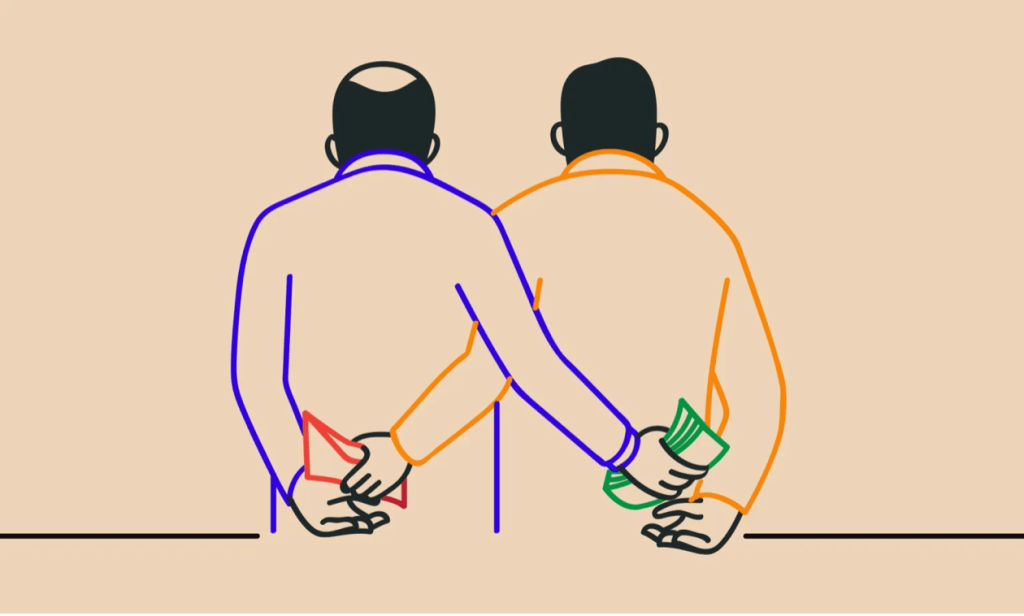
Sometimes, the most lucrative thing a person can do is stay silent. Right this second, hundreds or even millions of dollars are being traded for silence. Blackmail, bribes, under the table “gifts”—all of these are the fruits of corruption. In fact, The UN News estimates that 2.6 trillion dollars are lost per year due to corruption alone. Corruption is found in every country, though as with all things, how big of a problem it is varies.
The cost of bribery per year in the United States alone, as shown by the The United States Sentencing Committee, is approximately $8,357,370 and that in itself is probably a gross underestimation. This data is only based on the median amount of money that people are bribed with and the reported cases of it. So all in all, the cases that contain the highest bribes are rarely brought to light. In addition to that, the US is nowhere near the most corrupt state in the world.
So what is the most corrupt state in the world? How is it determined? Corruption is easily hidden and many countries would rather not dive deep into exposing or reporting it. Obviously, it is impossible to tell what the most corrupt state in the world is. However, the Corruption Perception Index is used as an imperfect, but useful tool to see trends of corruption in a country. The Corruption Perception Index (CPI) ranks countries based on how corrupt its citizens believe the country to be. To calculate the CPI, citizens are asked how corrupt they believe their country is, if they have been asked for a bribe in recent times or if they have received a bribe in recent times. All of these factors are used to give a score to the country in terms of perceived corruption. All of the surveyed countries are then given a score from 1-100, with 100 being the best score. From that score, the countries are then ranked in comparison to each other.
The data pertaining to the ranking of countries with the CPI is compiled and calculated by the Bureau of Labor and Statistics, but can be found on Transparency International. According to the data of 2024, Denmark is ranked first with a score of 90/100, the same score and ranking as last year. America is ranked 28th with a score of 65/100. Overall, the US CPI data from over the past few years shows an increase in perceived corruption. Out of the 180 countries that had data, the one that ranked the lowest was South Sudan with it being last place and having a score of 8/100. This makes sense considering the fact that South Sudan’s government had been struggling for years due to a power fight between Salva Kirr (the president) and Riek Machar (the vice president) in which Riek Machar was accused of trying to oust Salva Kirr, as explained by Times Magazine. Corruption in the country ran rampant from both sides of the power conflict.
On a global scale, the average score in 2024 was 42/100. While there were plenty of countries with high scores (mostly Western powers), countries with extremely low scores like Somalia with a 9/100 or Yemen with a 13/100 are a reminder that corruption is very much an issue in the world. According to the World Banks Blog, “A popular estimate is that more than $2.6 trillion, or 5% of global GDP, is lost to corruption annually around the world”. To put that into perspective Elon Musk’s net worth is only $324.3 billion. This 2.6 trillion dollars is lost through bribes, lies of omission, power plays, and under the table agreements. All of these incidences of corruption, both known and unknown, show the true cost of silence—2.6 trillion dollars.
Every country struggles with corruption, but especially those of developing countries. These countries are often war torn or former colonies. Due to imperialism, these countries did not have a strong government to rely on upon independence. They had been used to having their colonizers make decisions for them, whether they agreed with them or not. Therefore, former colonies have lost many centuries worth of self government progress. This leads to two scenarios: a happy ending where a strong, usually democratic, government is built or a tyranny in which government officials expect bribes from their starving citizens. All that money lost to corruption could have been used to reshape and build up the country. Yet, that money is used to fund gambling addiction, personal offshore accounts, or million dollar mansions. No development can be done and the vicious cycle of corruption continues.
Corruption is a nasty root in governments globally. The only way to stop it is for each country to be willing to acknowledge the corruption. They must unbury their heads out of the sand and see for themselves what corruption does to their country. Even if this corruption is beneficial to their country, their wealth, or their political party, no civilian anywhere should have to bear the consequences of this corruption. Corruption is built on a lack of respect for human life, for human labor. The only way to fight back must then be to relearn what could build back up so many governments and economies–empathy.
 The Overachiever