
by Julienne Absin (‘27)
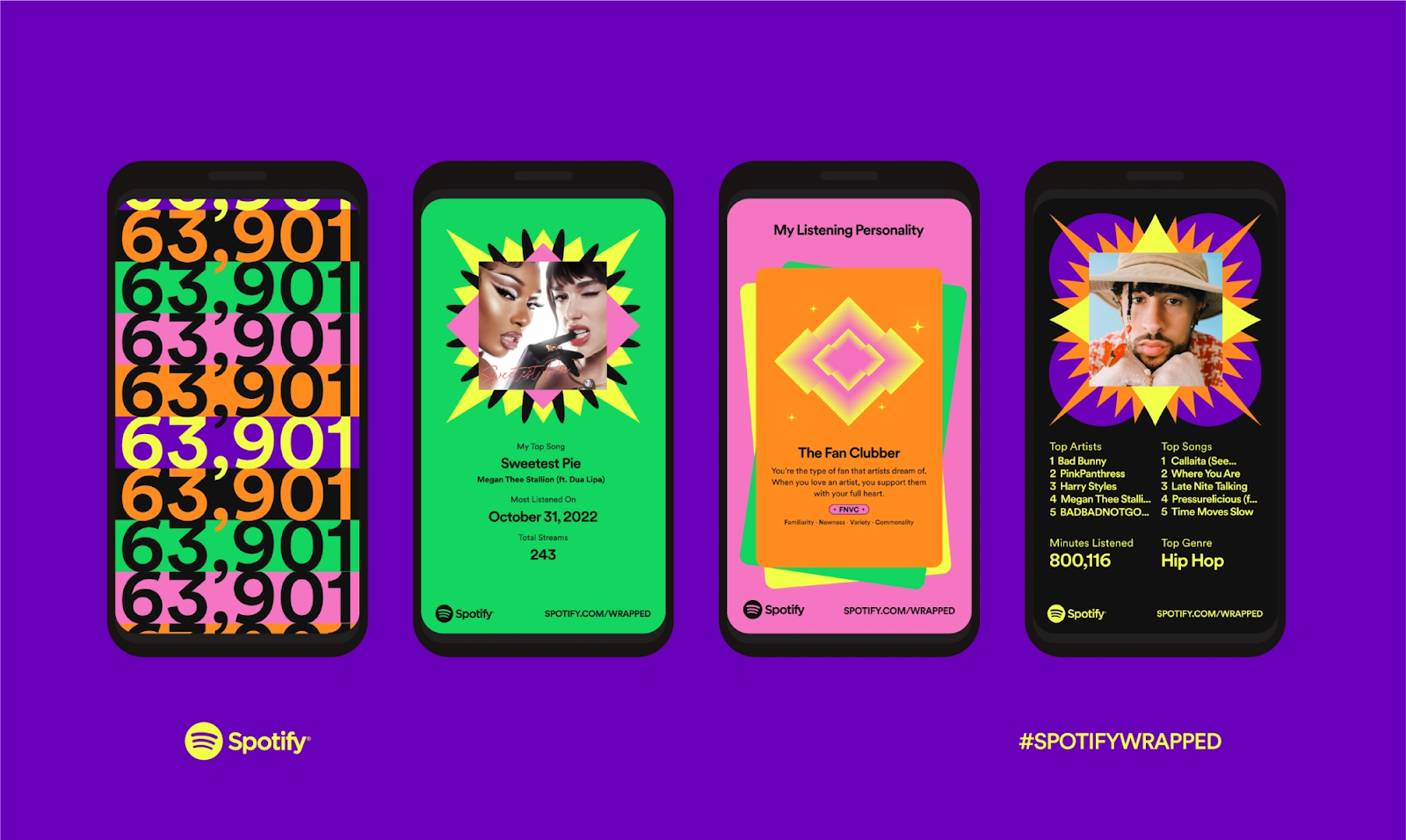
Surprise! Spotify Wrapped continues counting past October 31. Quick! You still have time to save yourself the embarrassment this year. Start streaming!
Late November to early December is the time for Spotify users to reflect on their played songs throughout the year. Social media sites are dominated by people posting about how they streamed their favorite artist for 150,000 minutes this year. People have flaunted about how they are in the top 0.05% of an artist’s listeners. This yearly tradition has secured the Sweden-based company a significant spot in current music culture. The deeper someone looks at this case, the more they will find that Spotify Wrapped, in its shareable Instagram story form, is a case of marketing genius.
In 2016, Spotify Wrapped was released in its iconic Instagram-inspired format. Prior to this release, Spotify introduced the in-app “Year in Music” playlist, but the hype over the former is what spotlights the company to this day. Still, some controversy surrounds the origins of the Spotify Wrapped idea as we know it. In 2019, former Spotify intern Jewel Ham allegedly proposed the idea of the story format, yet received no credit when the idea was actualized. This rumor has not been proven, thus Spotify has not turned over credit for the personalized structure that users know and love. However Spotify Wrapped came to be, it has proven itself to be a huge success among listeners globally. In 2021, 120 million Spotify users accessed their Spotify Wrapped. Three days after the release of Spotify Wrapped 2022, the social communication app X, formerly Twitter, blew up, reeling in over 400 million posts about the feature. Spotify itself considers Wrapped to be a “cultural phenomenon”.
Spotify Wrapped’s success could be explained through multiple factors, but it is primarily due to the need for an identity. As of recent years, Wrapped has evolved to be more than a compilation of users’ most listened to songs and artists. Listeners are also able to see their top genres and how many minutes they listened to an artist for. In 2023, Spotify introduced “Sound Towns”, for which Spotify would assign each user a town with listening habits that reflected the user’s own. For many, comparing Wrapped statistics is a light-hearted practice. For those who take their results more seriously, though, it feeds into music elitism, and makes people think that they have to prove something through their Wrapped. Perhaps they listened to too many guilty pleasures, or no longer want to associate themselves with their music taste earlier in the year. This need to “fix” their Wrapped only gives Spotify more streams, and eventually translates into more money for the billion-dollar company.
Additionally, Spotify Wrapped is appealing because of its availability. In the age of the Internet, algorithms have become more curated to the individual. Spotify is no exception, evident in the “Made For You” section on the app’s homepage. Users are used to being spoiled by having a personalized library of content, just like “Made For You”, easily accessible to them. In 2019, Spotify Wrapped officially became an in-app feature on IOS and Android. With Wrapped at users’ fingertips, traction increased and the feature built up popularity. Faster than one could say “Spotify Wrapped”, listeners could pull out the app and be able to strike up conversations about their results within seconds.
Payman Kassaie, the brand lead of Spotify as of 2020, says “There’s one part that is this digital, web, app experience that allows you to see how you listened throughout the year, and the other side of it is like a cultural brand campaign.” Like other businesses who have competition, Spotify works to differentiate itself from other music streaming services. Despite many lesser-known attempts at standing out, including the “Car Thing” of 2018, Spotify has found something that sticks with their audience. Sharing SpotifyWrapped on social media has become a tradition that is distinctly Spotify. Apple Music, Spotify’s competitor, has a similar feature to Wrapped, yet it is not heard about as often. Other companies have also taken this business model, such as Duolingo with their own “Year in Review”. Users have become encapsulated in the idea of “Spotify Wrapped”, and with the constant updates Spotify is giving it year after year, there’s doubt that this fascination will disappear soon.
Spotify Wrapped can be a great way to look back on listening trends and can reflect a person’s journey through music, which then can reflect their life. The picture it paints of an individual may reveal things outside of their favorite music. The list of someone’s top five artists doesn’t necessarily represent their favorite five artists of the year. It is only a measure of their most frequented artists. If someone bases their listening off of mood or activity, their Spotify Wrapped could actually represent how they felt most often, or how they spent most of their time throughout the year. For instance, if someone listens to a specific genre when they meditate, then that genre ends up being their number one on their Wrapped. That can mean that they spent much of their year in tranquil peace. That’s the power of music; it can reflect one’s life so precisely. Spotify definitely takes advantage of this connection with their personalized “In The Car” and “Workout” playlists. Spotify Wrapped is just another way to connect online streaming to the individual.
Just like everyone else, I will be looking at my Spotify Wrapped this year. I see it as an extra gift for the holiday season. It is so fascinating to see an overview of my habits every year, and even more so to see how excited people get to share their Wrapped with each other. I applaud the ingenuity behind Wrapped in its visual design, yearly additions and its unique connection with Spotify users. Wrapped is something special, and as we continue living in a digital streaming world, it provides a new way to appreciate music that is more accessible to all.
 The Overachiever