
by Hayden Frishman (‘27)
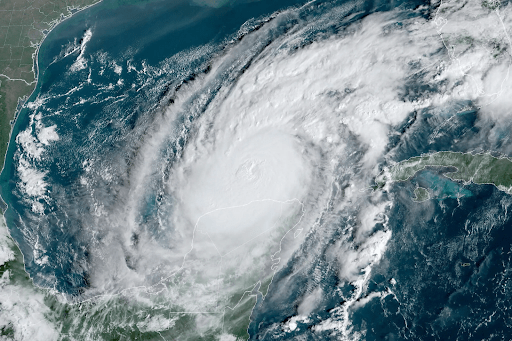
Imagine you are sitting on your couch at home, just waiting for a deadly storm to come. Then, water starts rising, and you realize that your home is gone. This storm is a hurricane, and two have hit the United States in the past month. Hurricane Helene made landfall on September 26, 2024, and Hurricane Milton made landfall on October 9, 2024. Not only have these hurricanes been within two weeks of each other, but humans could also be a part of the hurricane equation.
Hurricanes are created with four components: an external storm, warm ocean water, moisture in the atmosphere, and high winds. All hurricanes begin in the ocean, with warm and cold ocean water that mixes to create a tropical wave. To fuel these tropical cyclones, warm air mixes with the ocean water. Storms also add power to hurricanes by moving around the ocean water vigorously. Once there is an equal balance of these ingredients, a hurricane is born. If there is too much or too little of one part that makes up a hurricane, then the hurricane will filter out to be a smaller storm.
Furthermore, humans could be a part of why hurricanes are spawning so much, and being so destructive. People have been burning fossil fuels for years to create usable energy. But, when burned, fossil fuels release greenhouse gasses which rise into the atmosphere and trap extra heat into the Earth. Because of the heat, ocean water has become warmer than ever before. Warmer ocean water can intensify hurricanes quickly. For example, Hurricane Milton grew from a tropical storm to a category-five hurricane in under 24 hours.
Hurricane Helene hit Florida near its Gulf coast. Helene hit as a category four hurricane, and most everything seemed to be destroyed. There was no Wi-Fi for days, homes were torn down to their frames, roads were flooded, and debris flew about the region. Hurricane Helene not only affected the state of Florida, but also Georgia, the Carolinas, Tennessee, Virginia, and Kentucky. In North Carolina, there was rain, major flooding, and landslides. A resident of Brevard North Carolina, Gretchen Hogan, described Hurricane Helene by saying “It’s like a mini-apocalypse”.
Straight after Helene, Hurricane Milton came barreling into Florida’s Siesta Key as a category 3 storm. Just like Hurricane Helene, Milton brought some mass destruction to the state of Florida. Not only did about 10 people die, but the hurricane ripped up the roof of Tropicana field, took down power lines, and flooded homes and streets alike. Somehow, Milton also gave Florida the gift of deadly tornadoes. Because hurricanes have different bands, the outer band usually has rain and thunderstorms. Combining strong winds with the hurricane’s outer band can spawn a chain of tornadoes. In this awful natural disaster, about 125 homes were taken to the ground.
As climate change is threatening our world with more hurricanes than ever before, it is very important to help out the world in any way possible. Two back-to-back hurricanes have been devastating for the United States, whether or not your home is located in one of the states impacted. Be sure to stay safe, and listen to government officials’ warnings. Natural disasters do not affect just a certain region, but the entire world.
 The Overachiever