
By: Analie Nguyen (‘26)
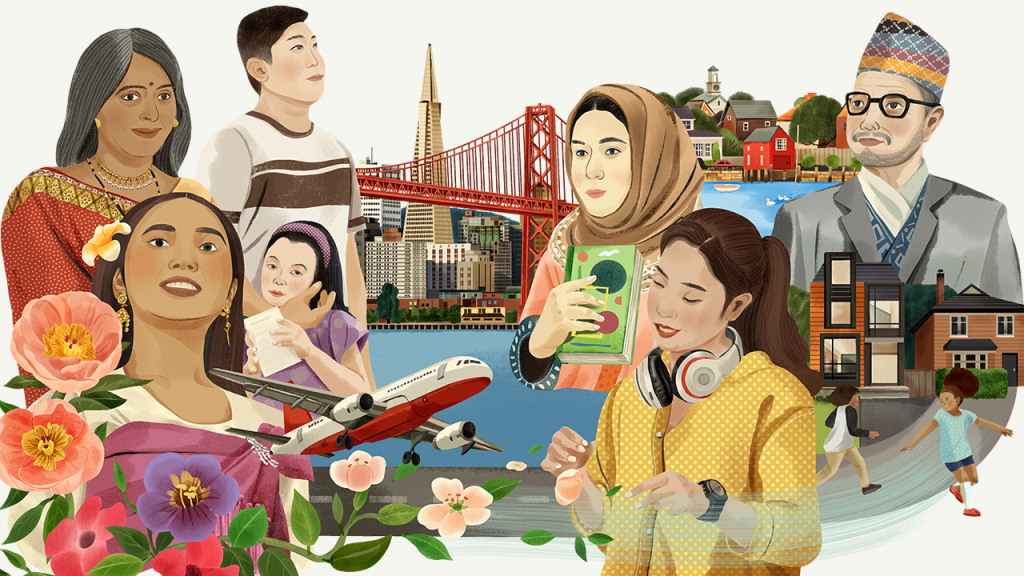
(Photo from Pew Research Center)
When I was younger, I lived in a predominantly white community. To illustrate, out of 800 students in my elementary school, there were 4 Asian kids: my sister, my cousins, and me. It was not a very diverse community. Coupled with the fact that kids are usually ignorant and immature, it was not easy being Asian.
Of course, I’m not trying to fault any of my old classmates. If anything, it was the accidental ignorance of the community that caused their kids to know very little about Asian culture. Without fail, every kid would ask me, “Do you eat dog?” Was that all they thought Asian people ate? Because of societal ignorance, to these kids, Asian food was reduced to dogs.
Even with other Asian food, kids weren’t so forgiving. My cousin had bought a purple sweet potato for her kindergarten field day. I still remember her coming home and telling me a kid had asked if it was poop. A minor mistake, maybe, but one that makes me wonder if the kid would have still said that if he had seen a potato.
Growing up, Asian food was a daily occurrence. We were a middle-class immigrant family, and that meant that most of our meals were Vietnamese food. Yet, I never remember appreciating it that much. All of my favorite foods when I was younger were American and never Vietnamese. In fact, I disliked a lot more Asian food than I did American food. I hate to admit it, but I had never thought about why that was the case.
There are two possibilities. Due to the fact that American food was a rare treat, perhaps I just instantly liked it more. It’s a classic representation of “little supply means high demand”. Marketing teams had cracked the code long ago and realized that slapping “limited edition” or “special” onto their products meant that kids would eat it all up. Maybe something similar had happened to me because of the restriction of American food in my life.
Or, there is a theory that is much more disturbing. I grew up in a time before the “representation wave”. Most of the things I watched or read were about Caucasian main characters. Dork Diaries, Magic Tree House, Best friends Whenever—I consumed a lot of stories, and 99% percent of them had Caucasian main characters. So, all I ever saw was their food. I wanted to be like the character in all these shows and books. I wonder, and I fear, that perhaps I loved American food so much because I wanted to be cool like the characters I’d seen, that for some reason my Asianess seemed like a barrier for that goal. Perhaps I had seen those characters eat those foods and deemed that my food was not the same, and ergo something that separated them and me.
When I was around 12 years old, I moved to a predominantly Vietnamese community. There, Asian people were the majority. It was a huge culture shock. In some areas, all you could see for a hundred yards were Asians upon Asians. It was at this point that I learned to have a little more pride in my culture. Being Asian was normal in Houston, Texas. Asian food was extremely common. In fact, my parents had moved to Texas to open up a Vietnamese to-go restaurant. Every Saturday after Mass, my family and I would head to the shop to close up. Any and all leftovers were up for grabs. I spent my late tweens and early teens eating Vietnamese street food like chuoi chien (fried bananas), bánh tiêu (fried dough), and banh mi (Vietnamese style baguette). At the same time, Asian culture, particularly Korean and Japanese, was becoming increasingly popular. It became “trendy” to be Asian or to try Asian foods. And just like that, the first Asian food people thought of was no longer dog, but kimchi, sushi, or sometimes even pho. It was a stark contrast to people’s previous attitudes.
Now, I am 17 years old. I live in a diverse community, one where I am neither a majority nor a minority. I just am. I sometimes wonder about those kids from my early years—whether they still ask other Asians if they eat dogs. I wonder if they have learned better—if they have learned to ask if the Asian person eats bibimbap, samsa, or momos. I wonder if they ever think about how undermining their assumptions had been. Most of all, I wonder where they learned these stereotypes. Asian street food is full of so many dishes. Yet, why was dog the only one they remembered? Why was it the first one taught to them? Who taught it to them—years of generational ignorance or TV? You see, to me, Asian street food was a blessing that gave me my dignity back. While I am not ashamed that part of Asian cuisine is dog (food is food and everyone needs to eat), Asian food should be known for more than that. And Asian street food was the key to that. Quick to eat and easy to buy food—it became a trend and completely expanded the American dictionary of Asian food.
So to answer a question that I had insinuated in the title: “Street food–what does it mean to an Asian American like me?”, to me, street food was a way of getting back a piece of dignity that I had lost more than a decade ago. It was something to be proud of. It was something to heal the misconceptions of millions of Americans. And for that, I will always smile whenever I see an Asian street food post. So for that, thank you.
Thank you for making me proud to be Asian.
 The Overachiever