
By Isabella Nestor (’26)
TW: Mention of Depression, Suicide, and Animal Abuse
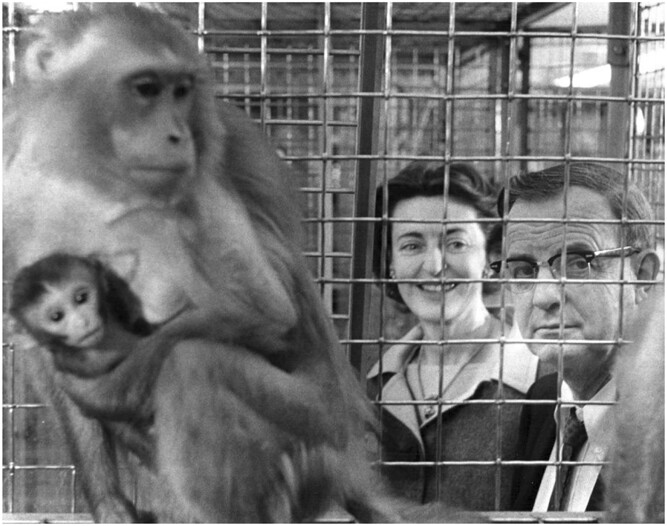
With more and more people pursuing the field of psychology it is important to remember the uncertain time in which it was developed. Almost every high school psychology student has heard of the study by Harry Harlow on attachment theory, but other than grazing the surface of his findings, people often miss out on the grave psychological story of the study, often called, “Harlow’s pit of despair”. Harry Harlow, a psychologist awarded for his findings on attachment which changed hospital protocols, however, his methods were less than humane and highly controversial. In his studies, Harlow abused dozens of monkeys by traumatizing them. Upon further inspection of this study, ethics analysts agree that no study should be done of this caliber again. As a result, the requirements of what is deemed a study, ethics have changed. Regardless, it is important to look into the reasons for this study to begin with, and for that, one must understand the trauma that Harlow went through himself. By understanding his mania, one can truly see the reasons for his need to understand the reasons for his depression, and through this exploration, we can see the manic man he became beforehand and afterward.
Harlow’s first experiments made him a famous psychologist. It was only after these successful studies did he tried to go into the field of depression by finding ways to depress monkeys. As unethical as this was, it was done in a series of trials to determine whether isolation, discomfort, or hatred made monkeys the most depressed. By the end of the prologue of the experiments, isolation was the number one factor that Harlow found to be most depressing. The experiments were driven by an extreme sense of needing to know what was wrong with himself and simply to find a solution to his depressing life problems. Once, Harlow stated that “depression rarely leads to love, but love frequently leads to depression as we all know” when interviewed about his pursuit of knowledge. And indefinitely, these themes had appeared true in his lifetime. While conducting the famous rhesus monkey studies, Harlow’s second wife was on her deathbed with cancer. Deeply affected by his losses, Harlow spent time in the Mayo Clinic mental institute with the sole goal of finding a cure for depression. This information alone makes it clear that the state of mind that he was in was not suitable for a professional psychologist.
Harlow’s chronic bouts of depression caused him to be incredibly anxious throughout his life which made him more susceptible to bouts of depression in the future. Ridiculously, Harlow became depressed every time he got a scientific achievement because he was afraid it would be his last. Although at the beginning of his depression, he wasn’t suicidal, this quickly changed throughout his life. His attitude about death changed so drastically that he would give detailed descriptions of the ways that he would kill himself. Harlow’s depression also leaked into his everyday life with frequent overdoses and intoxications. He was known to have a horrible drinking problem and often overdosed on sleeping pills causing him to end up in the hospital on many occasions. Ironically, it was these bad habits that led to his award as the most prestigious doctor in all of America, for which he would have to give a speech. The pressure on this occasion was so intense that as a procrastinator, Harlow was unable to do his work and ended up with physical depression as well. Unable to live up to his awards, he drove himself to the Mayo Clinic where he was treated for his madness and where he truly became determined to find a cure for depression.
It was at this clinic that Harlow realized the shortcomings of modern physicists. The activities at the clinic were so mundane and isolated that it drove Harlow into madness further. Ironically, according to Harlow, the group therapy sessions were too straightforward: they only asked the same two questions every time. His experience in the mental hospital most likely led Harlow to isolate his monkeys in the future as he was isolated, himself, from all of reality. When the treatment at the Mayo Clinic was ineffective, the final straw was ECT (electroconvulsive shock therapy), a method that he deemed incapable of being effective due to the lack of research in the field. After the ECT, Harlow had improved, however, the scars that were inflicted upon him from his long battle with anxiety and depression had not faded. In his pursuit of knowledge, Harlow was cold and senseless when he tested the rhesus monkeys, partly because he had been in the same position himself. Torturing the monkeys for effective recovery and medicine for depression seemed to him like a worthy cost-benefit analysis.
Regardless, Harlow may have reflected his trauma of bad parenting onto his experiments. There were moments where he could see the exact impact of isolation and loneliness on the Rhesus monkeys and related it to himself and his insanity. These moments may have even brought him joy to see the things that past psychologists did not dare to see. However, the cruelty he inflicted on not only the monkeys but also himself and those around him is possibly a result of his uneven upbringing. Regardless of whether or not the damage he witnessed on the monkeys was done to him, the continuance of that brutality was what made Harlow a truly unprofessional madman. Not only does his trauma change the results of his studies, but it also changed the ways he perceived depression (which in itself is a large realm of emotional issues not restricted to isolation and loneliness). Harlow was spoiled in a way, never took his awards for granted, and never saw his achievements as anything more than fuel for the pursuit of knowledge. The argument, however, is whether or not his research was worth the lives of those monkeys. Even if Harlow changed the information about attachment in countless textbooks, he built the definition of depression based on his own experiences in a truly unprofessional and biased way.
 The Overachiever