
by María José Alvarez Toribio (‘27)
Trigger Warnings: mentions of femicide, sexual assault, violence, and domestic abuse.
I spent a long time being told lies about feminism and what it means to be a feminist. Many people misinterpret feminism, deeming it synonymous with man-hating, but this could not be further from the truth. Before I moved to the US three years ago, I wasn’t aware that the meaning of feminism differed by culture and context. I learned that things people view as symbols of equality and empowerment are entirely different in the US and Mexico. Although I was not familiar with the American flavor of reclamation of the rights of women, I have been with Mexico’s. For a while, I became used to being told not to associate myself with the “savage” women who screamed through the streets of Mexico City, protesting for their voices to be heard. As I learned more, it became increasingly clear what they were screaming for, who they were screaming for, and what and who they were screaming at.
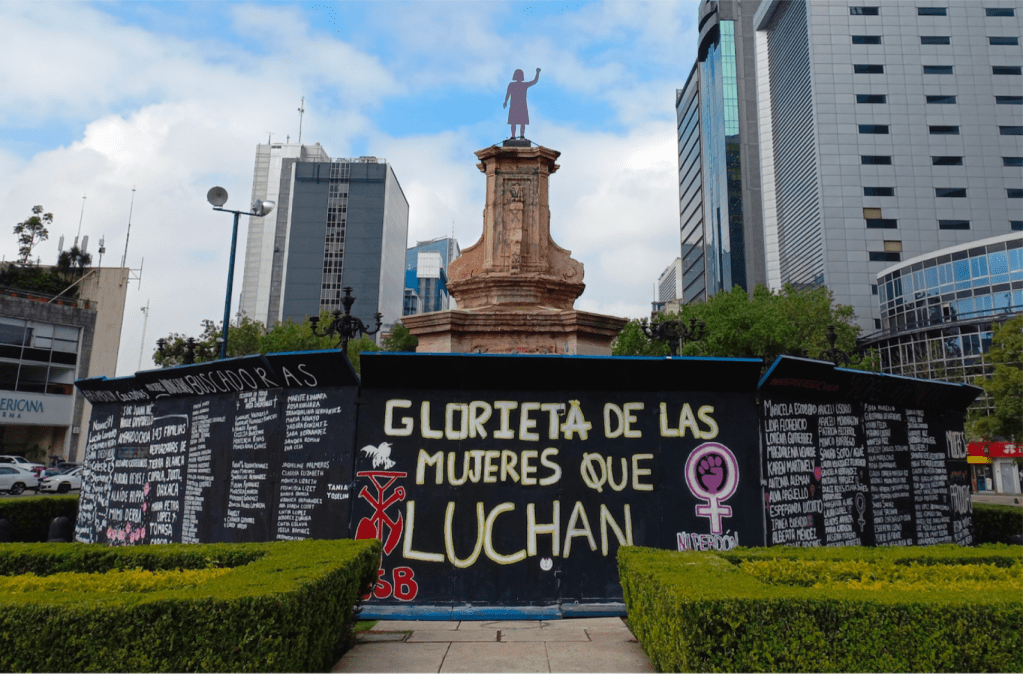
The premise of feminism is the same worldwide, but the experience of truly being a part of it differs when the struggles between women are put into different perspectives. While women everywhere struggle with sexism in the workplace, at school, at home, and throughout their daily lives, some women struggle with it in a much deeper way. For instance, two different people from distinct backgrounds and with dissimilar economic situations will encounter different adversities. Both struggles are valid, but one side of the situation is more privileged than the other. Recognizing and advocating for both of these women in different measures is the difference between white feminism and intersectional feminism. White feminism only takes into account the women who are privileged and is highly biased to support them over women of color, low income, etc. On the other hand, intersectionality stands for inclusivity and prioritizing the freedom of those who are at a disadvantage, while still accounting for all women. White feminism is just another term for unauthentic feminism. Unlike the term advertises, white feminists are not all white, and not all of the people who are white and are feminists are inherently white feminists. The terminology does not refer to caucasian people not being “real” feminists, but the perpetration of exclusiveness and white supremacy. White people can be intersectional feminists, and people of color can be white feminists.
By definition, feminism is the belief in full social, economic, and political equality for women. This is a privilege most women in Mexico do not have, and it should not be treated as a privilege. It should be the standard and the bare minimum to have a social system that does not alienate women and protects them against violence. Just in 2022, 3,754 women and girls were murdered, out of which only 947 (33.7%) were investigated as femicides. In June of 2023 alone, there were also 27, 389 recorded cases of domestic abuse, and 80 recorded femicides. Most of the violence against women in Mexico goes uninvestigated and about 90% of convicted rapists go unpunished. Gender violence in Mexico is mostly due to the set gender roles that run deep in the culture and Catholicism.
Every 8th of March, thousands of women gather in the most important and popular street of Mexico City, Reforma, to protest against gender violence. During the protests, many women chant and walk around the street. The “Ni Una Menos” (not one less) movement has become one of the most popular among feminists in Latin America. It originated on June 3rd, 2015 when a pregnant 14-year-old girl named Chiara Paéz was brutally murdered in Argentina. Her body was found on the 10th of May, 2015. After her story became known, thousands of women all around Argentina took over the streets in protest. To this day, many still tell her story as a clear example of gender violence in Latin America and as a way to raise awareness on the matter.
Women’s Day is not an event to be celebrated in Mexico. It is a day of mourning those who were taken advantage of, assaulted, killed, and were never accounted for. It is a day to remember the women and girls who have been subjected to the deep-rooted sexism that exists in Mexico and all around the world. It is also a day to commemorate the women who, against all odds, have paved the way for newer generations to have a better life than they did. It is not a day to give people flowers, and it is not a day to stop fighting for social, economic, and political equality between the genders.
 The Overachiever